Caffeine and Alcohol: What They Really Do to Your Sleep
How late-day coffee and the evening glass of wine change your sleep architecture — with realistic cutoff times that don't require quitting either one.
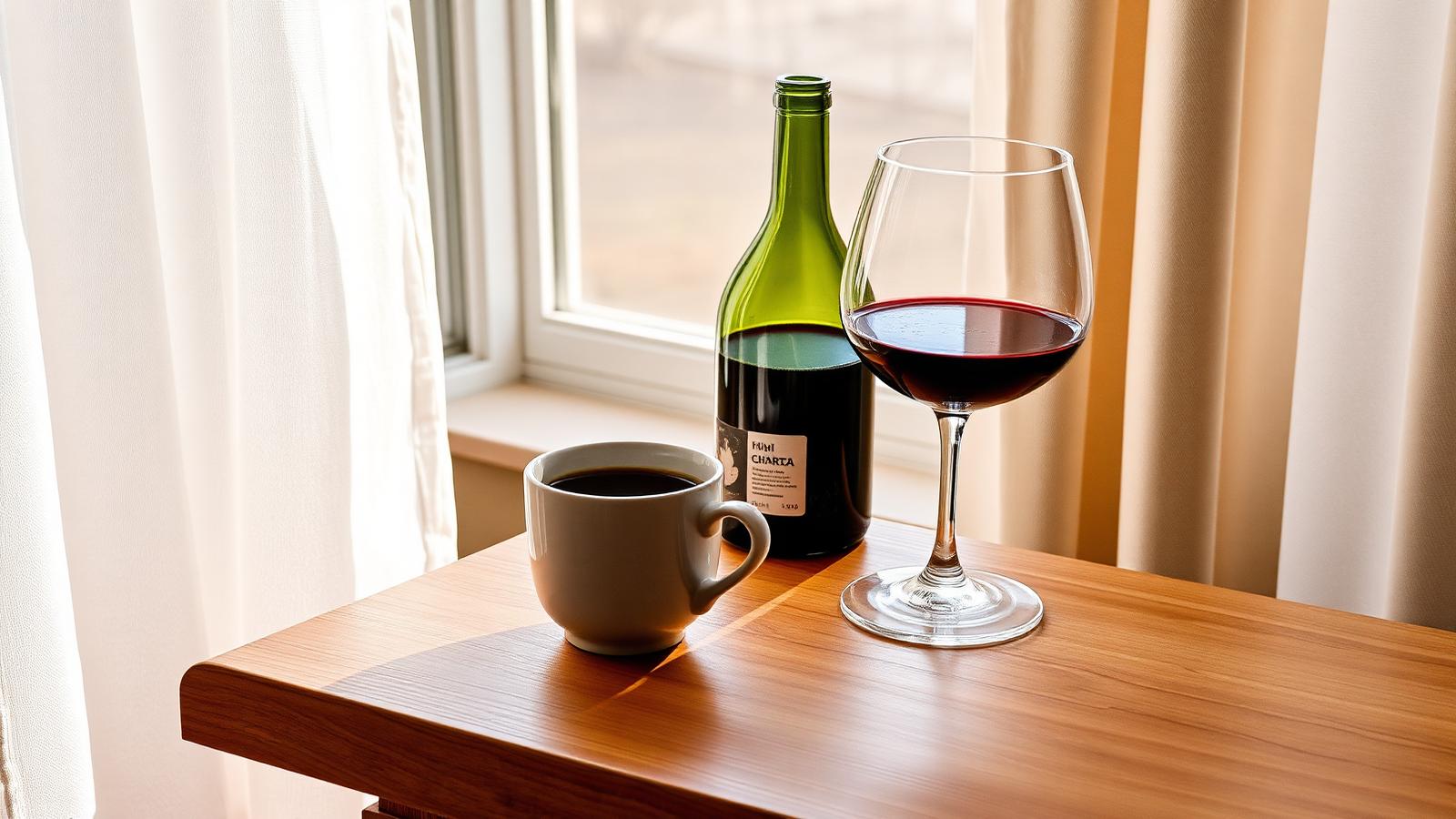
Two substances shape more sleep outcomes than every gadget and supplement combined, and most people are misinformed about both. Caffeine gets blamed for keeping you awake — its real damage is quieter than that. Alcohol gets credit for helping you fall asleep — which it does, right before it takes the night apart. Neither has to be eliminated. Both have to be timed.
Caffeine: the sleep-pressure blocker
While you're awake, a molecule called adenosine accumulates in the brain. The more that piles up, the sleepier you feel. That accumulation is sleep pressure, and it's one of the two systems (along with the circadian clock) that determine when you fall asleep and how deeply.
Caffeine doesn't remove adenosine. It parks in the same receptors so your brain can't read the signal. The adenosine keeps building the entire time. When the caffeine finally clears, all of it registers at once — the well-known afternoon crash. This is also why caffeine can wreck sleep quality even when you fall asleep without difficulty: you're going to bed with the adenosine signal partially blocked, so sleep pressure is lower than it should be, and deep sleep suffers.
Half-life is the number that matters
Caffeine's half-life averages five to six hours, meaning half is still circulating that long after your last sip. A 200 mg coffee at 3 p.m. leaves about 100 mg in your system at 9 p.m. and roughly 50 mg at 3 a.m. Genetics matter here: variations in the CYP1A2 enzyme mean some people clear caffeine in three hours and others take nine. If coffee at noon affects your night, you're a slow metabolizer, and that isn't something willpower changes.
- Standard advice: last caffeine 8–10 hours before bed. For an 11 p.m. bedtime, that's a 1–3 p.m. cutoff.
- Slow metabolizers or anyone sensitive: make it a noon cutoff, or morning only.
- Watch the hidden sources — green tea, matcha, dark chocolate, pre-workout, some pain relievers, and most sodas.
- Decaf is not caffeine-free; a cup carries roughly 2–15 mg. Usually irrelevant, occasionally not.
One more habit worth changing: delay your first coffee by 60 to 90 minutes after waking. Cortisol is already peaking in that window, so the caffeine adds little, and drinking it later spreads coverage across the day and pulls your cutoff earlier without feeling like a sacrifice.
Alcohol: the sedative that isn't sleep
Alcohol is a central nervous system depressant. It shortens the time it takes to fall asleep, which is why so many people use it as a nightcap and swear it works. What follows is the problem.
First half: REM suppression
Alcohol substantially suppresses REM sleep in the first half of the night. REM handles emotional processing and memory consolidation, so losing it shows up as irritability, blunted mood, and foggy recall the next day — symptoms people usually attribute to the drinking itself rather than the missing REM.
Second half: rebound wakefulness
As your liver clears the alcohol, the sedative effect reverses into a stimulant rebound. Heart rate climbs, sleep gets shallow and fragmented, and you wake — often between 2 and 4 a.m., often sweating, often unable to get back down. There's usually a REM rebound too: unusually vivid, sometimes unpleasant dreams as the brain reclaims what it was denied.
The other effects
- Muscle relaxation in the airway increases snoring and can convert mild sleep apnea into serious apnea for the night
- Alcohol is a diuretic — expect at least one extra bathroom trip
- It raises core body temperature during metabolism, working directly against the cooling your body needs to hold deep sleep
- Even one drink measurably reduces heart rate variability overnight, a common marker of poor recovery on wearables
Alcohol trades ten minutes of falling asleep faster for two or three hours of worse sleep. It's a loan at a terrible rate.
Realistic timing that works
You don't have to quit. Give your body roughly one hour per standard drink before bed — three drinks, three hours, minimum. Two hours is a reasonable floor even for a single glass. Keep total drinks low on nights before something that matters, alternate with water, and eat with the drinks so absorption slows. Do that and most of the second-half fragmentation flattens out.
The evening swap list
- Caffeinated tea after 2 p.m. → rooibos, chamomile, or peppermint
- Nightcap → sparkling water with bitters, or a warm tart cherry juice
- Late espresso after dinner out → decaf, or skip and order dessert instead
- Pre-workout for a 6 p.m. session → non-stimulant version, or move the caffeine to the morning session
Why the bedroom still matters
Both substances raise your body temperature and increase night wakings, which means a bedroom that already runs hot compounds the damage. If you drink at all in the evening — or if you're a slow caffeine metabolizer working on your cutoff — cooling matters more for you than for most people. Breathable bedding, a 65–68°F room, and a mattress that moves air rather than storing it will not undo three glasses of wine, but they remove the second cause of the same 3 a.m. wakeup.
Linden's hybrid build — pocket coils for airflow, a latex-blend comfort layer instead of heat-trapping memory foam, and a natural-fiber cover — is designed around that cooling curve. Try it for 120 nights and you'll have plenty of data on which nights were the mattress and which were the nightcap.
Remove the other reason you wake at 3 a.m.
See the Linden mattress