Best Mattress for Stomach Sleepers: What Actually Works
Stomach sleeping is the hardest position on your spine. Here's the firmness, materials, and pillow setup that keep it comfortable.
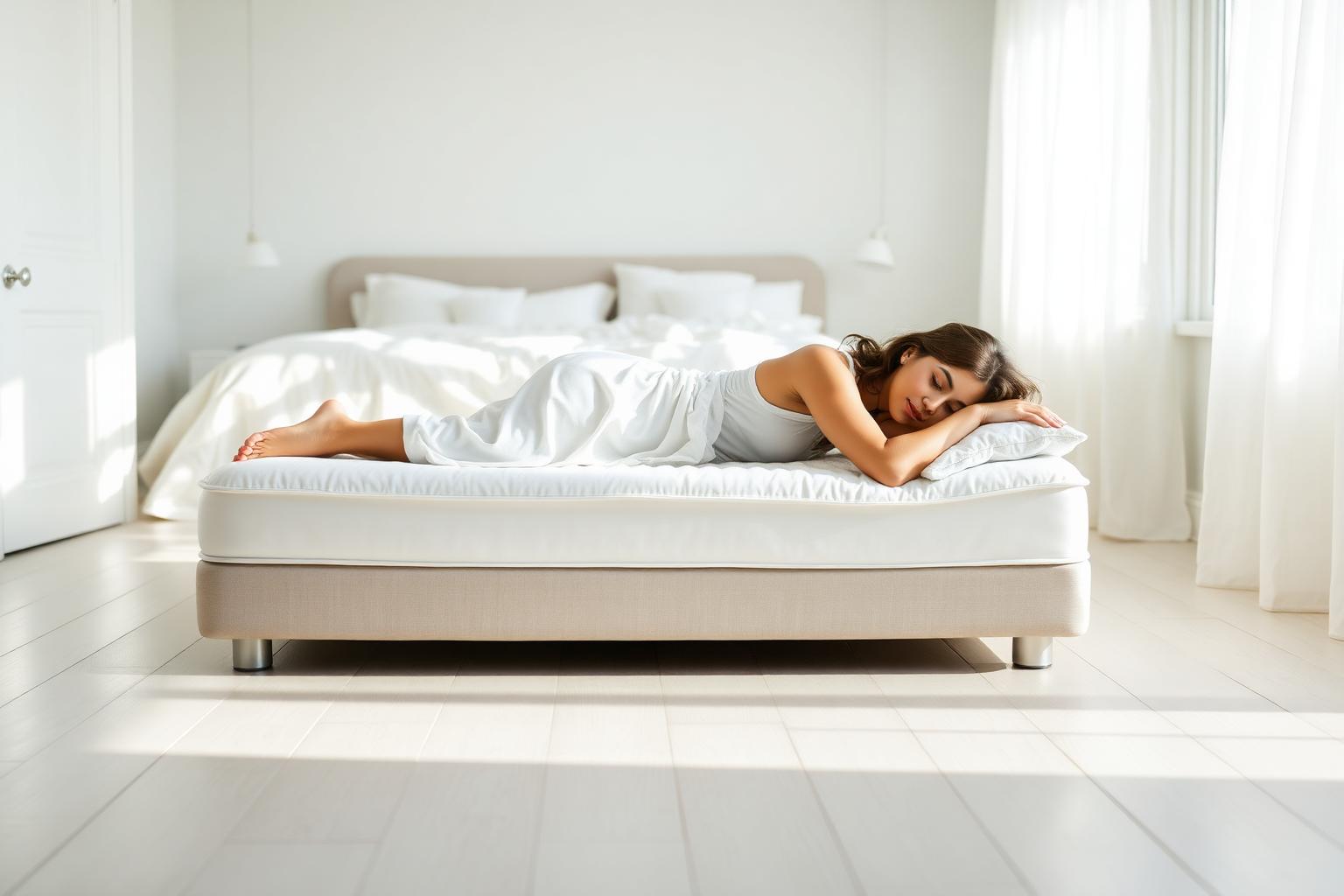
Stomach sleepers are a minority — somewhere around ten to fifteen percent of adults — and the mattress market mostly ignores them. That's a problem, because stomach sleeping is the most mechanically demanding position you can ask a mattress to support. Get the surface wrong and you're setting up a nightly tug-of-war with your lower back and neck.
This guide explains what your spine is doing when you sleep face-down, why firmness matters more here than in any other position, and how to set up the rest of the bed — pillow included — so you wake up without the familiar ache.
The biomechanics problem
When you lie on your stomach, your body weight concentrates in the heaviest part of your torso — the hips and pelvis. On a soft mattress, that mass sinks deepest, and your lumbar spine is pulled into hyperextension: an exaggerated arch that compresses the facet joints and tightens the lower-back muscles all night. The result is the classic stomach-sleeper complaint — a stiff, aching lower back that's worst first thing in the morning and eases as you move around.
The second problem is your neck. Sleeping face-down requires rotating your head to one side to breathe, and holding that rotation for hours strains the cervical joints and the muscles between the shoulder blades. The mattress can't fix the neck issue entirely — your pillow and head position do most of that work — but the wrong surface makes it worse by twisting the whole spinal chain.
Firmness: this is not the place for plush

Stomach sleepers need the firmest mattresses of any sleep position. The goal is simple: keep the pelvis level with the ribcage so the lumbar spine stays neutral. For most adults that means a 6.5 to 8 on the standard 10-point firmness scale. Lighter stomach sleepers (under 130 pounds) can sometimes get away with a 6; heavier stomach sleepers should be looking at 7.5 and up.
The trap to avoid is 'faux firmness' — a mattress with a thin firm top over a soft core. It feels supportive for the first ten minutes, then the comfort layer compresses under your hips and you're back in the hammock. Real support comes from the core: a firm coil system or high-density support foam that resists compression under load, not just at the surface.
Materials that work (and ones that don't)
Hybrids are the safest choice. A pocketed-coil core provides pushback exactly where your hips load the mattress, and a thin, responsive comfort layer on top — latex is ideal — keeps the surface from feeling like a board. Latex deserves special mention: its buoyant, springy character holds you 'on' the mattress rather than letting you sink 'in,' which is precisely what a stomach sleeper's spine needs.
Deep memory foam is the material to be most careful with. Slow-response foams let the hips sink gradually through the night, so you can fall asleep aligned and wake up arched. If you love the feel of foam, look for a firm hybrid with a foam comfort layer of two inches or less over a genuinely firm core.
The pillow matters more than you think
- Use the thinnest pillow you can tolerate — or none at all. A thick pillow cranks the neck backward on top of its sideways rotation.
- Consider a pillow under your pelvis. A slim pillow under the hips reduces lumbar hyperextension on mattresses that are slightly too soft.
- Alternate the side your head faces. Always turning the same direction loads one side of the neck night after night.
- A body pillow hugged against your chest can partially convert you to a side-stomach hybrid position, which is far kinder to the spine.
Should you just... stop sleeping on your stomach?
Most sleep clinicians will gently suggest it, because side and back sleeping are easier on the spine. But position habits are deeply ingrained — most people who try to force a change end up back on their stomach within weeks, just with worse sleep in the meantime. The pragmatic approach: optimize the bed for the position you actually sleep in, and if you want to transition, do it gradually with a body pillow rather than by willpower.
Testing a mattress as a stomach sleeper
In a showroom, lie face-down for at least ten minutes with your head turned the way you actually sleep. Slide a hand under your hips — if there's a gap between your pelvis and the surface, or if you feel your lower back tightening, move on. At home during a trial, the tell is morning symptoms: lower-back stiffness that fades within an hour of waking is the mattress telling you the hips are sinking.
The Linden Firm was built with this position in mind — a supportive pocketed-coil core under a responsive comfort layer, with enough give to keep the surface comfortable and enough structure to keep the pelvis level. The 120-night trial gives you four months to confirm it in the only test that matters.
Support where stomach sleepers need it
Shop the Linden Firm